PIMRON(Pimobendan)
1.25mg/2.5mg/5mg
Chewable Tablets
Cardiac drug for oral use in dogs only
Description:
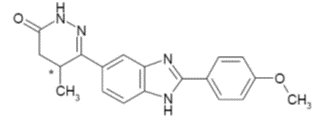
PIMRON (pimobendan) is supplied as oblong half-scored chewable tablets containing 1.25, 2.5, 5 or 10 mg pimobendan per tablet. Pimobendan, a benzimidazole-pyridazinone derivative, is a nonsympathomimetic, non-glycoside inotropic drug with vasodilatative properties. Pimobendan exerts a stimulatory myocardial effect by a dual mechanism of action consisting of an increase in calcium sensitivity of cardiac myofilaments and inhibition of phosphodiesterase (Type III). Pimobendan exhibits vasodilating activity by inhibiting phosphodiesterase III activity. The chemical name of pimobendan is 4,5-dihydro-6-[2-(4-methoxyphenyl)-1H-benzimidazole-5-yl]-5-methyl-3(2H)-pyridazinone. The structural formula of pimobendan is:
Indications:
PIMRON is indicated for the management of the signs of mild, moderate, or severe congestive heart failure in dogs due to clinical myxomatous mitral valve disease (MMVD) or dilated cardiomyopathy (DCM). Pimron is indicated for use with concurrent therapy for congestive heart failure (e.g.,furosemide, etc.) as appropriate on a case-by-case basis.
Dosage and Administration:
PIMRON should be administered orally at a total daily dose of 0.23 mg/lb (0.5 mg/kg) body weight, using a suitable combination of whole or half tablets. The total daily dose should be divided into 2 portions that are not necessarily equal, and the portions should be administered approximately 12 hours apart (i.e., morning and evening). The tablets are scored and the calculated dosage should be provided to the nearest half tablet increment.
Contraindications:
PIMRON should not be given in cases of hypertrophic cardiomyopathy, aortic stenosis, or any other clinical condition where an augmentation of cardiac output is inappropriate for functional or anatomical reasons.
Warnings:
User Safety Warnings: Not for use in humans. Keep this and all medications out of reach of children. Consult a physician in case of accidental ingestion by humans.
Animal Safety Warnings: Keep PIMRON in a secure location out of reach of dogs, cats, and other animals to prevent accidental ingestion or overdose.
Only for use in dogs with clinical evidence of heart failure. At 3 and 5 times the recommended dosage, administered over a 6-month period of time, PIMRON caused an exaggerated hemodynamic response in the normal dog heart, which was associated with cardiac pathology (See Target Animal Safety).
Adverse Reactions:
PIMRON is relatively safe as side effects are often considered rare and uncommon with the medication. However, it is not extremely uncommon for pets to experience gastrointestinal issues, such as diarrhea, after beginning the medication. Ensure your dog remains well-hydrated if they begin experiencing diarrhea at any time
In some instances, your pet may begin to experience additional GI issues on top of diarrhea, such as a lack of appetite. General lethargy, weakness, and a lack of energy may also be noticeable for pets that are just starting PIMRON.
More serious side effects to watch for that may indicate the need for assistance from a veterinarian include:
Rash or increased redness of the skin
Difficulty breathing, increased wheezing
Racing or abnormal heartbeat
Fainting or collapsing
Bruising or bleeding
Distended or painful abdomen
Yellowing of the gums or the whites of the eyes
If these PIMRON for dogs side effects appear after you begin administering the medication to your dog, call your veterinarian immediately.
Clinical Pharmacology:
PIMRON is rapidly absorbed through oral administration, with a bioavailability of 60-65%. When taken with food, the bioavailability is significantly reduced. It undergoes hepatic metabolism to an active metabolite (desmethylpimobendan). The parent compound, pimobendan, is an effective calcium sensitizer, while desmethyl PIMROM is a more potent phosphodiesterase III inhibitor. The half-life of PIMRON in the bloodstream is 0.4 hours, and the metabolite has a half-life of 2 hours. Elimination occurs through biliary excretion, followed by fecal excretion. PIMROM binds to plasma proteins in circulation at a rate of 90-95%. This may have an impact on patients with low blood protein levels (hypoproteinemia/hypoalbuminemia) and those undergoing concurrent therapy with high-protein-binding agents.
Storage Information:
Store at 20° to 25°C (68° to 77°F), excursions permitted between 15° and 30°C (between 59° and 86°F).
How Supplied:
PIMRON Chewable Tablets:
Available as 1.25mg/2.5mg/5mg oblong half-scored chewable tablets – 30 tablets per bottle.
Manufacturer :
Egn Veterinary Laboratory
Product of the India
Marketed by:
Generic Animal Drugs Thailand Co.,Ltd
Adress :Nuanchan 25 Alley Nawamin Bueng kum Bangkok Thailand
Email : info@petsgad.com
Generic medication and its counterpart to have the same active ingredients, strength, quality, route of administration, and safety standards.All of our products are produced in GMP factories, Your pet’s health is our top priority.
Revised: December 2023
This summary contains important information about PIMRON. You should read this information before you start giving your dog PIMRON and review it each time the prescription is refilled as there may be new information. This sheet is provided only as a summary and does not take the place of instructions from your veterinarian. Talk with your veterinarian if you do not understand any of this information or if you want to know more about PIMRON.
What is PIMRON ?
PIMRON is a PDE3 (phosphodiesterase III) inhibitor, which increases cardiac contractility while dilating arterioles. In the simplest terms, it helps to relax blood vessels, thus lowering blood pressure and helping the heart to pump blood properly.
PIMRON is a drug commonly given to veterinary patients with heart failure. It’s usually used in dogs, but may occasionally be prescribed to cats. It’s one of the most useful and well-tested drugs for veterinary cardiac patients, and it has a good safety record.
What are the indications for PIMRON?
Primarily used to treat congestive heart failure (CHF) in dogs with dilated cardiomyopathy and degenerative valvular disease:
Late-stage ACVIM B2-phase degenerative mitral valve disease
Late-stage preclinical dilated cardiomyopathy
Pulmonary arterial hypertension (pulmonary hypertension), especially in patients with active CHF
Arrhythmogenic right ventricular cardiomyopathy with concurrent myocardial dysfunction
Used off-label for CHF in cats secondary to various forms of myocardial disease.
What are the side effects of PIMRON?
PIMRON is relatively safe as side effects are often considered rare and uncommon with the medication. However, it is not extremely uncommon for pets to experience gastrointestinal issues, such as diarrhea, after beginning the medication. Ensure your dog remains well-hydrated if they begin experiencing diarrhea at any time.
In some instances, your pet may begin to experience additional GI issues on top of diarrhea, such as a lack of appetite. General lethargy, weakness, and a lack of energy may also be noticeable for pets that are just starting PIMRON.
More serious side effects to watch for that may indicate the need for assistance from a veterinarian include:
Rash or increased redness of the skin
Difficulty breathing, increased wheezing
Racing or abnormal heartbeat
Fainting or collapsing
Bruising or bleeding
Distended or painful abdomen
Yellowing of the gums or the whites of the eyes
If these PIMRON for dogs side effects appear after you begin administering the medication to your dog, call your veterinarian immediately.
What drug interactions should be noted when using PIMRON?
PIMRON is typically used in combination with three other drugs to alleviate heart failure in dogs (pulmonary edema, pleural effusion, ascites). These are:Furosemide,Spironolactone,An ACE inhibitor.
Pets receiving PIMRON should exercise caution when using the following drugs: calcium channel blockers (verapamil and diltiazem) and beta-blockers (propranolol, atenolol).
Be sure to inform your veterinarian of any medications your pet is taking (including vitamins, supplements, or herbal therapies).
What if I miss giving my pet the medication?
If you miss a dose, give it when you remember, but if it is close to the time for the next dose, skip the dose you missed and give it at the next scheduled time, and return to the regular dosing schedule. Never give your pet two doses at once or give extra doses.
Are there any risk factors for this medication?
PIMRON should not be used in pets that are allergic to it. It should also be avoided in pets with hypertrophic cardiomyopathy, aortic stenosis, or other conditions where an increase in cardiac input is inappropriate. Use this medication with caution in pets with uncontrolled abnormal heart rhythms. It is unknown if this medication is safe for young, breeding, pregnant, or lactating pets, or in pets with congenital heart defects, diabetes, or other metabolic disorders, so it should be used with caution in these cases.
Is there any monitoring that needs to be done with this medication?
There is no specific monitoring that needs to be done while your pet is taking this medication. Your veterinarian may monitor your pet to be sure that the medication is working.
What should I do in case of emergency?
If you suspect an overdose or an adverse reaction to the medication, call your veterinary office immediately. If they are not available, follow their directions in contacting an emergency facility.